Showing posts with label flooding. Show all posts

Tuesday, 27 January 2026

Derriere Delight & Rapid Chain Consumption


Having switched saddles and riding conditions milder and wetter, I switched to Muffin and some fixed gear serenity before things flip flopped again. Reunited with the titanium railed Spa Aire, I was delighted with the comfort but also noted some slight slip with these Castelli Competizone Bib Tights Castelli Competizione Men’s Bib Tights | cycling-not-racing- the case with the Ergon it replaces.

With another snowy blast on the horizon, I switched Ursla from the CST Patrol CST Patrol Folding EPS Tyres | cycling-not-racing to Schwalbe’s Ice Spiker Pro Schwalbe Ice Spiker Pro Tyres | cycling-not-racing. Wheels in situ, I then decided a chain check was opportune- .75 when I introduced my more basic, nickel-plated tool. Bin fodder either way.

I had two in stock, so no issues on that front. Simply brake, prune the new and click into place with the magic link. Now was also the opportunity to expel some gunge clinging to the jockey wheels and lighter grime adorning the rings. Something also prompted me to check Denise’s KMC- said nickel-plated gauge also slid straight to .75.

Again, an easy fix, and chance to strip some residual gunk from the jockey wheels, cage and rings.  Both chains had been fed the Muc Off C3 All Weather Chain Lube Muc-Off C3 All Weather Chain Lube | cycling-not-racing . This also serves to illustrate how persistent exposure to waterlogged roads, mucky lanes, trails and of course snow and salt rapidly consume drivetrains-even with disciplined cleaning and light lubrication. Denise’s chain was only replaced in November. I subscribe to the philosophy of buying less exotic chains, since they still return a reasonable mileage and are relatively kind on the wallet when replacement’s due. Same goes for cassettes.

Rings should be fine, so long as you’re not lax when it comes to replacing chains. However, there’s an argument for investing in stainless steel, rather than 6061 aluminium alloy rings. At least on a tourer, or other bikes that do big mileages year-round. Mercifully, the Deore FC M5100 fitted to Ursula and Denise are steel, which adds a few grams but theoretically repays with improved durability.

Again, Deore is often regarded as entry-level, but the specification and performance are still very impressive. Back in the 1990s, I had high regard for Shimano’s STX & RC components, good enough for racing, but affordable and economic to replace, should you bend something beyond repair in a crash.  They key with all these things is to keep repairs, replacements and upgrades practical. Unless a gift, or passed to you at an incredibly favourable rate, bolting high end CNC machined rings on lower to mid-range cranks makes no sense.      

All this also serves as solid argument for running a fixed, or single speed steed as a primary winter bike. One ideally with full length mudguards (fenders). That said, fixed and single speed drivetrains are low maintenance, decent sprockets and chains are key, since they’re under a fair bit of strain and that’s before you throw the witches brew of wet, salt, grit and similar nasties into the mix.

Without doubt, the best sprocket I’ve ever run was EAI Superstar- a beautifully machined, highly polished stainless-steel affair commanding £45. EAI also offer a less exotic steel stablemate for £25. One that arguably strikes the best balance of value and performance on a working, or training bike.

I’m also suitably impressed by the Andel Fixed Sprocket (1/8 17tooth) fitted to Muffin. I’m not a fan of electroplating per se. I appreciate it looks pretty but I don’t like the process and acids involved. Nonetheless, Muffin’s seems to be holding up very well against the elements and offers a winter, knee friendly ratio of 67.5.

Great for a smooth, struggle-free cadence, but without going into overdrive on the descents.  As for chains, I’ve had surprisingly good results from budget KMC, such as the Z510, their higher end stainless counterparts, not to mention, the Gusset S Link and thus far, this Izumi. Once upon a time, while riding conversions I ran 3/32 Sedis, but it’s been 1 1/8th track fare all the way since I took advantage of fixed’s resurgence in 2005.    


Wednesday, 28 February 2024

Good Housekeeping


No, not that one, I am of course referring to keeping drivetrains sludge-free and lightly lubed. I’ve decided since it’s been milder and drier to dress Ursula’s chain in the NZero Wax. OK, so the arrival of this Muc Off Chain Cleaner brush influenced this decision.  

The fixed’s Z1 is still sporting a healthy amount of NZ wet lube- impressive, given the typically wet conditions. I’ll be sticking with it for now and for the Z1’s life. I’ll then switch to the Gusset S-link and possibly something lighter. However, I’m becoming increasingly enamoured to the NZero Wet lube.    

In common with other wet blends in these, the lube has been migrating towards the outer plates. However. I was surprised to find in drier contexts this has fallen away. Much like a traditional wax formula. It is suitably stubborn-I'm past the 200-mile marker despite the onslaught of filthy, flooded roads. Transfer to hands is very easy, and removal equally stubborn, however. Something I was reminded of while adjusting the fixed’s chain tension. For this reason, pack disposable/ mechanics gloves in case you should need to fix a flat, or some other mechanical by the road, or trailside.   

I’m happy to feed the Holdsworth’s KMC chain wax formulas since it’s a summer/sunny days’ build, and in the heat, waxes tend to melt deep into the rollers, then flake off.  

Dry lubes and waxes can also prove useful on bikes in storage, preventing corrosion, without attracting dirt. Teenage Dream and Holdsworth’s chains have remained blemish-free and dressed in a protective glaze. For these reasons, they’re also good choices for bikes serving on indoor trainers. I’ve heard stories of wax lubes being at the root of component demise-chains gnawing through derailleur cages.  

I’ve never seen it myself but that’s not to say it doesn’t happen. However, I’m of the belief this resulted from a cook-up, home-brewed formula. I’m thinking paraffin, Xylene, and similar base components, which have assumed too thick a consistency. Too early to comment on the NZero Wax’s staying prowess but I’m finding some definite appeal in the curing speed and cleanlinessI’ve also received these Blub wax and ceramic lubes for testing, so there may be a lot of competition and it will theoretically keep me out of mischief for a little bit.   

Then of course, there are drier blends such as the Momum MIC Wax Momum MIC Wax Lube | cycling-not-racing (sevendaycyclist.com). These tend to run cleaner and are closer in nature to dry lubes, albeit more durable, so my preference for a potentially changeable spring and summer, where I want a lube to run clean, but also stay put. This is also quite welcome if you’ve put a summer bike in storage.    

Stout lubes and tyres are not the only considerations when it comes to enjoying winter and early season riding but dependability goes a long way 

I also found an opportunity to inspect and ultimately re-grease Ursula’s Cirrus Cycles Kinekt2.1 Suspension Seat post KINEKT 2.1 SUSPENSION SEAT POST | cycling-not-racing (sevendaycyclist.com) and the seat collar binder bolt. I blasted a little HC-B1 inside the seat tube and treated the chainstay bridge chip to some high-build primer. The rear fender is functional but a likely candidate for upgrade, although contemporary designs are intended for framesets with disc, not cantilever mounts 


The Pirelli Angel DT Urban Tyre Pirelli Angel DT Urban Tyre | cycling-not-racing (sevendaycyclist.com) have proven themselves in some challenging contexts and the puncture-repelling belt has been effective despite mud, thorns and hedge clippings. It’s not a substitute for good maintenance or weekly once-overs, mind.   

Check spare tubes, pumps, patch kits and other spares, or regret it when you’re in the arse end of nowhere. I like Topeak products per se but am particularly fond of the Topeak Uni Super Tourist DX rack and this Topeak  Road Master Blaster Frame Fit Pump Topeak Road Master Blaster Frame Pump | cycling-not-racing (sevendaycyclist.com) 

Talking of racks, the Topeak MTX Trunk Dry Bag continues to impress with its refinement and weatherproofing. The semi-rigid foam insert has also proved highly effective at damping vibration-I've brought eggs mid-ride and returned with them intact. That said; I wouldn’t be toting cameras and other sensitive electricals in there- that goes for all rack-top models. Lined bar bags are the best hosts for cameras 

Saturday, 7 March 2020

Too Much Pressure?


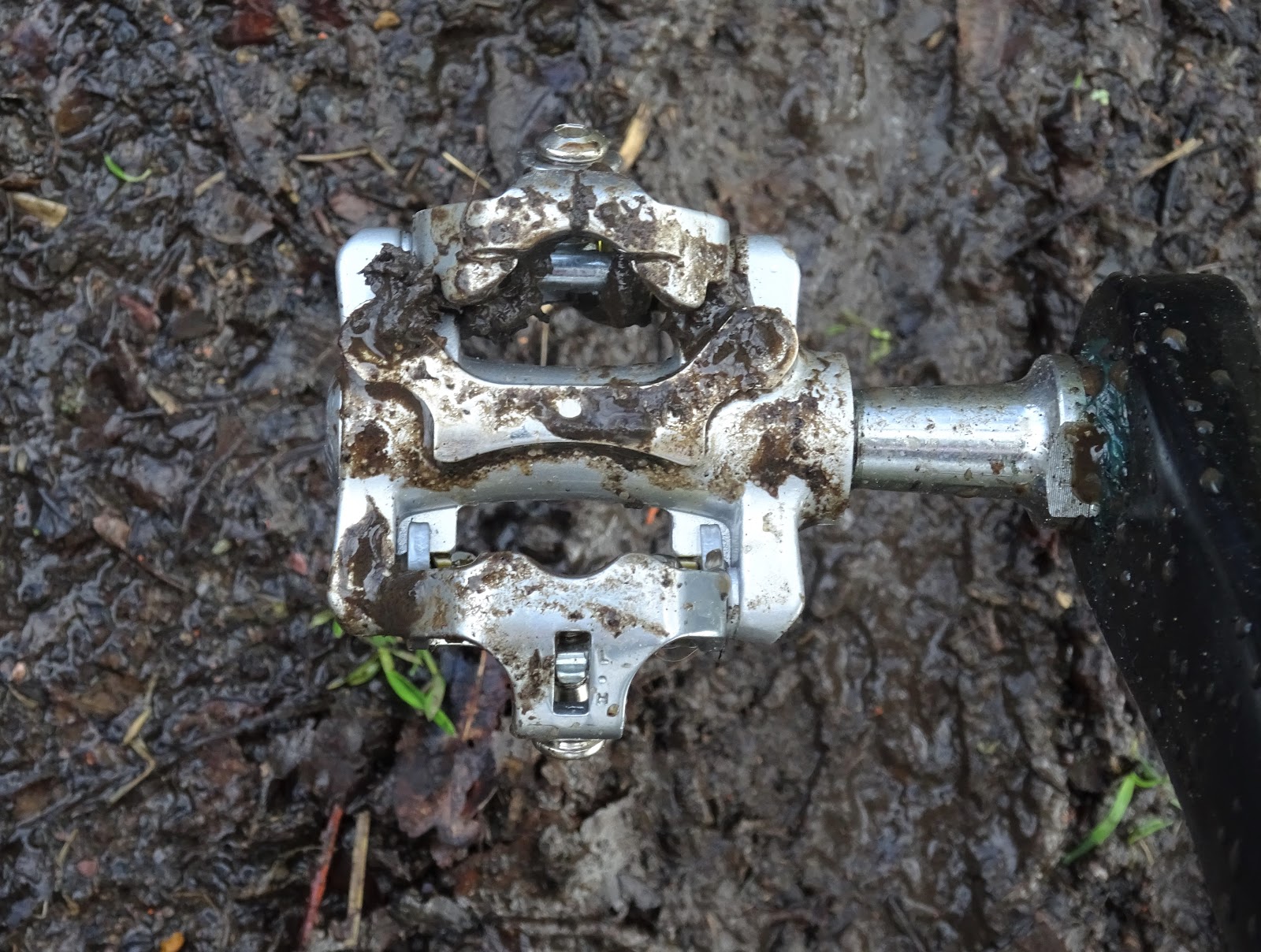
There’s been no relent in the wet weather. Thankfully, my Univega’s dressed for foul conditions and mixed terrain service. Besides, I needed to test the mud-shedding prowess of these Wellgo MO94B pedals https://www.sevendaycyclist.com/wellgo-m094 and cast my own, personalised imprint in the Cycles Berthound Solour leather saddle. 

After 85 miles, the latter and I were in friendly acquaintance territory, 150 miles in and the friendship is blossoming. Regular feeding of the hide, using Proofide, or a similar quality leather preserve also helps accelerate this process. Once forming is complete, feeding need only be done every 6 weeks or so.  

Existing gearing was low enough to winch myself through the thick, boggy mud. However, I’ve concluded a 38 (rather than 40) tooth ring would strike the elusive sweet spot. Enough zoom for the flat and descents, just a little more grunt on the climbs.  

Production 5 arm 94 BCD rings are getting harder to source (although I am advised that Stronglight still list them). I’m not prepared to pay “classic” prices for NOS (New Old Stock) rings either. However, the existing Talon ring is in rude health and if something suitable comes along, brilliant, if not the gearing is, in the main, perfectly serviceable. 

While I’m delighted that high quality, small scale manufacturing/engineering is very much alive, sourcing products from Europe and indeed, elsewhere could become fraught with difficulty, come 2021.  

Unfortunately, highly skilled engineering and similar vocational education is (and has long been) regarded as a poor second to academic learning. A long-standing snobbery, which is neither accurate nor desirable.  

I graduated 25 years ago, during a recession. During this period, I was also keen on pursuing a new life in the Netherlands. I had a girlfriend studying there. Catching her aside her housemate (who had a 1st class honours degree), seemingly ingesting his enviable intellect saw any love for her evaporate, replaced by a strengthening bond to the Dutch.  

One thing led to another and I decided to check out the cross-country mountain bike scene there. I met an ex-pat and former banker who had relocated from the UK and retrained as a skilled machinist. Decent salary and standard of living, too. He’d never looked back. 

For the uninitiated, a skilled machinist operates machine tools to manufacture and repair precision equipment. It requires a solid understanding and application of mechanics, metals, layout and machining procedures. Apprentice trained engineers are life-lomg learners by nature and continuously develop their knowledge/skillset.  

The same is not necessarily true of University graduates, regardless of specialism-at least, here in the UK.  In the late 90’s, the UK administration introduced life-long learning accounts. A system, which was well-intentioned and originally aimed at people made redundant, when traditional industries collapsed.  

Unfortunately, this didn’t reach the intended/target audience, so it was quietly disbanded. It was recently resurrected as part of the Liberal Democrats’ election manifesto, and once again, been consigned to the vaults of history.  

Observing the patterns, I do not feel we will reach a point of total automation, where human labour/skills are made redundant but the skills required (and to some extent, legal/insurance implications) will need to change and it is quite possible that many people will be unable to make these transitions.   

These will not replace important “soft” skills, such as emotional intelligence, which are also incredibly important, in any role requiring human interaction. For example, a heating engineer who communicates well and problem solves on this level, is also likely to have more customers than one who is technically very competent but lacking in inter-personal abilities.   

I’ve been chatting a lot about handlebars in recent entries, specifically Soma Condor and Genetic’s D-Riser family. These are riser drops and some would argue, more specialist than required by some road-biased riders. Arguably, components on complete bikes should be proportional to frame size e.g. stem length, bar width etc.  

Similarly, there is a perfectly reasonable argument for making substitutions/upgrades at the point of sale. Tyre and saddles are two prime examples. This has changed slightly, given modern retailing- the switch to online, rather than physical shop consultations and purchases.  

However, unless something is obviously the wrong width/pattern/size, there’s an argument for running stuff a little while, then upgrading/replacing at a later stage.  At £30, Steve reckons the Genetic STV Road Handlebars are a great starting point for generic, road-biased riding.     https://www.sevendaycyclist.com/genetic-stv-road-handlebars 

Continuing my theme, some inexpensive but cheerful “Lifeline” branded tooling arrived, including this digital tyre gauge. Even though those fitted to most track pumps have much closer affinity to reality, getting pressures spot on gets the best from tyres and ride quality. Capable of registering 160psi, the digital is a little small, compared with a  Topeak Smartguage I had some 15 years back.   

However, in common with this premium quality SKS unit (that’s been loyal to me for a decade, or so), it features a useful backlight. Another similarity is the dual (rather than “smart”) valve head. There’s no denying the “Smart” type, which automatically morph to fit Schrader/Presta heads are super convenient.  

However, in my experience, the sprung mechanism is their Achille's heel, eventually going the self-destruct route. It also features a bleed valve, for quick tweaks and runs from the ubiquitous CR2032 button battery.  

Giving change from £10, it doesn’t feel fragile but it will be interesting to see how accurate and durable it proves. The backlight and valve light and similar features suggest it’s intended to be taken along for the ride.  

Given the price point, if it did take a bad knock, then cheap enough to replace. Nonetheless, I’m more inclined to carry an analogue model, such as this Revolution, since there’s no risk of accidental, battery draining engagement.         

There is a perception among some, that tough tyres “suck the joy out of riding”. However, this needn’t be the case. The Schwalbe Marathon GT https://www.sevendaycyclist.com/schwalbe-marathon-gt-tyres are relatively portly but still deliver a very smooth and relatively quick ride.  
I’ve had a couple of flats over the past few years and countless thousand miles. 800 odd grams is pretty much as portly as I’d want to go. Nonetheless, I’d prefer a few additional grams and reclaim riding time, over tending punctures on dark, rainy nights.